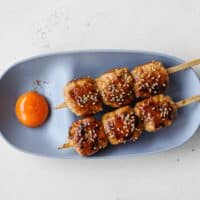
Tsukune (Japanese Chicken Meatballs)
Inspired by the tsukune I ate in Tokyo, these juicy Japanese chicken meatballs are pan-fried, glazed with sweet-savoury tare and ready in 30 minutes.
Servings: 4
Calories: 546kcal
Ingredients
Meatballs
- 650 g chicken thighs
- ½ tsp white pepper
- 1 tsp salt
- 1 tsp soy sauce
- 1 tbsp sake
- 1 tbsp potato starch (or cornstarch/cornflour)
- 25 g panko breadcrumbs
- 1 egg
- 80 g onion (finely minced)
Other Ingredients
- 2 tbsp vegetable oil (for frying the tsukune)
- sesame seeds (optional)
Instructions
Prepare the tsukune mixture
- Using a food processor, pulse blend the chicken pieces to make a thick, rough paste.
- Mix in all the other meatball ingredients with your hands until it's very well combined. Refrigerate while you make the tare sauce.
Make the tare
- Combine the ginger, sugar, sake, mirin and soy sauce in a small saucepan.
- Stir and bring to a gentle simmer. Cook gently uncovered for 15-20 minutes, until reduced and lightly syrupy.
- Remove the ginger. Set the sauce aside—it will thicken further as it cools.
Portion and shape
- Dampen your hands and, weigh out around 30 g per meatball and roll into compact balls. You should get approximately 28.
- If using skewers, thread three meatballs per skewer, slightly flattening them.
- Arrange on a platter that is lined with plastic wrap. If you layer the tsukune place a sheet of plastic wrap between to avoid sticking. Refrigerate for 1 hour.
Cook and glaze
- Heat a lightly oiled frying pan over a medium heat until hot.
- Carefully place the meatballs in the pan (you may need to cook in batches). Leave undisturbed for 2 minutes before carefully flipping. Leave for a further 2 minutes then, cook for a further 4 minutes turning frequently.
- Turn down the heat and brush over a thin coating of tare and continue cooking and turning for another 1 minute, being careful to not let the tsukune burn (the sugar in the sauce can caramelise quickly).
- Serve immediately with extra tare on the side. Optional: Add a light sprinkling of toasted sesame seeds.
Notes
Recipe Tips – Things I’ve Learned
- Chicken thighs give me the best results – I’ve made tsukune with both thigh and breast meat, and thighs consistently produce the juiciest, most flavourful meatballs. Pre-ground chicken still works, but is often leaner and a little drier.
- Really work the mixture – I mix it firmly with my hands until it becomes well combined and sticky. I’ve found this develops the characteristic springy texture and helps the meatballs stay together.
- Damp hands make shaping much easier – The mixture is naturally sticky, so I keep a small bowl of water nearby and lightly wet my hands between meatballs.
- I weigh the portions – Around 30g per meatball gives me approximately 28 evenly sized tsukune that cook at the same rate.
- Chilling makes a noticeable difference – I refrigerate the shaped tsukune for an hour. They become much easier to handle and hold their shape better, especially on skewers or the BBQ.
- Leave them alone at first – I don’t touch the frying tsukune for the first 2 minutes on each side. Once the exterior has firmed up, they’re much easier to turn without sticking or falling apart.
- Add the tare at the very end – I learned quickly that its sugar can burn before the chicken cooks. I reduce the heat, apply a thin coating and turn the tsukune continuously for the final minute.
- Cook in batches when needed – Overcrowding my pan causes the meatballs to steam rather than brown, so I leave a little space around each one.
- Use a thermometer for certainty – I check the centre of one of the largest meatballs and make sure it has reached at least 75°C/167°F.
- The BBQ adds another dimension – My pan version is the one I cook most often, but when the BBQ is already fired up, the extra smokiness is absolutely worth it.
Nutrition
Calories: 546kcal | Carbohydrates: 29g | Protein: 32g | Fat: 32g | Saturated Fat: 8g | Polyunsaturated Fat: 8g | Monounsaturated Fat: 12g | Trans Fat: 0.2g | Cholesterol: 200mg | Sodium: 2414mg | Potassium: 472mg | Fiber: 1g | Sugar: 15g | Vitamin A: 187IU | Vitamin C: 2mg | Calcium: 44mg | Iron: 2mg